The players: Alice and Bob.
# # Alice and Bob are in separate locations and cannot communicate once the game # begins. Prior to the game however, Alice and Bob are free to communicate with # each other. In addition to the players, there is also another party in this # game that is referred to as the *referee*. # # {.center} # #The referee.
# # Alice and Bob want to play in a cooperative fashion against the referee. # # Now that we have set the stage with respect to the actors and actresses we will # encounter in this game, let us see how the game is actually played. # # 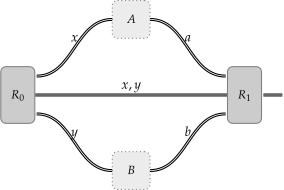{.center} # #A two-player nonlocal game.
# # A nonlocal game unfolds in the following manner. # # 1. The referee randomly generates questions denoted as $x$ and $y$. # The referee sends the question $x$ to Alice and the question # $y$ to Bob. The referee also keeps a copy of $x$ and # $y$ for reference. # # 2. Alice and Bob each receive their respective questions. They are then each # expected to respond to their questions with answers that we denote as # $a$ and $b$. Alice sends $a$ to the referee, and Bob # sends $b$. # # 3. When the referee receives $a$ and $b$ from Alice and Bob, # the referee evaluates a particular function that is predicated on the # questions $x$ and $y$ as well as the answers $a$ and # $b$. The outcome of this function is either $0$ or # $1$, where an outcome of $0$ indicates a loss for Alice and # Bob and an outcome of $1$ indicates a win for Alice and Bob. # # # Alice and Bob's goal in the above game is to get the function in Step-3 to # output a $1$, or equivalently, to indicate a winning outcome. This type # of game is referred to as a *nonlocal game*. # # ## Classical and Quantum Strategies # # Now that we have the framework for a nonlocal game, we can consider the # player's *strategy*; how the players play the game given access to certain # resources. There are a number of strategies that the players can use, but for # simplicity, we will restrict our attention to two types of strategies. # # 1. *Classical strategies*: The players answer the questions in a deterministic # manner. # # 2. *Quantum strategies*: The players make use of quantum resources in the form # of a shared quantum state and respective sets of measurements. # # # ### Classical strategies # # A *classical strategy* for a nonlocal game is one where the players # deterministically produce an output for every possible combination of inputs # they may receive in the game. The *classical value* of a nonlocal game is the # maximum probability achieved by the players over all classical strategies. For # a nonlocal game, $G$, we use $\omega(G)$ to represent the classical # value of $G$. # # One question you may have is whether a classical strategy can be improved by # introducing randomness. If the players randomly select their answers, is it # possible for them to do potentially better than if they had just played # deterministically? As it happens, probabilistic classical strategies cannot # perform any better than deterministic classical strategies. # # There is therefore no loss in generality in restricting our analysis of # classical strategies to deterministic ones and it is assumed that when we use # the term classical strategy that we implicitly mean a classical strategy that # is played deterministically. # # ### Quantum strategies # # A *quantum strategy* for a nonlocal game is one where the players prepare a # quantum state prior to the start of the game along with respective sets of # measurements that they apply to their respective portions of the shared state # during the game based on the questions they receive to generate their answers. # The *quantum value* of a nonlocal game is the maximum probability achieved by # the players over all quantum strategies. For a nonlocal game, $G$, we use # $\omega^*(G)$ to represent the quantum value of $G$. # # 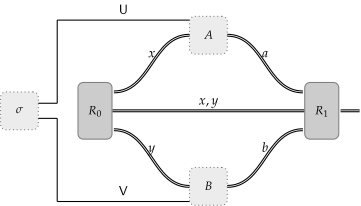{.center} #A two-player nonlocal game invoking a quantum strategy.
# # Let us describe the high-level steps for how Alice and Bob play using a quantum # strategy. # # 1. Alice and Bob prepare a state # $\sigma \in \text{D}(\mathcal{U} \otimes \mathcal{V})$ prior to the # start of the game. We use $\textsf{U}$ and $\textsf{V}$ to # denote the respective registers of spaces $\textsf{U}$ and # $\textsf{V}$. # # 2. The referee sends question $x \in \Sigma_A$ to Alice and # $y \in \Sigma_B$ to Bob. # # 3. Alice and Bob perform a *measurement* on their system. The outcome of # this measurement yields their answers $a \in \Gamma_A$ and # $b \in \Gamma_B$. Specifically, Alice and Bob have collections of # measurements # # $$ # \begin{aligned} # \{ A_a^x : a \in \Gamma_{\text{A}} \} \subset \text{Pos}(\mathcal{U}) # \quad \text{and} \quad # \{ B_b^y : b \in \Gamma_{\text{B}} \} \subset \text{Pos}(\mathcal{V}), # \end{aligned} # $$ # # such that the measurements satisfy # # $$ # \begin{aligned} # \sum_{a \in \Gamma_A} A_a^x = \mathbb{I}_{\mathcal{U}} # \quad \text{and} \quad # \sum_{b \in \Gamma_B} B_b^y = \mathbb{I}_{\mathcal{V}} # \end{aligned} # $$ # # *4.* The referee determines whether Alice and Bob win or lose, based on the # questions $x$ and $y$ as well as the answers $a$ and # $b$. # # # For certain games, the probability that the players obtain a winning outcome is # higher if they use a quantum strategy as opposed to a classical one. This # striking separation is one primary motivation to study nonlocal games, as it # provides examples of tasks that benefit from the manipulation of quantum # information. # # ## Calculating the classical value # # The *classical value* of a nonlocal game is the maximum winning probability # over all deterministic strategies. Since probabilistic classical strategies # cannot outperform deterministic ones, computing the classical value reduces to # a brute-force search over all possible deterministic strategy pairs # $(f, g)$ where $f: \Sigma_A \to \Gamma_A$ and # $g: \Sigma_B \to \Gamma_B$. # # Formally, the classical value is: # # $$ # \omega(G) = \max_{f, g} \sum_{(x,y) \in \Sigma} \pi(x,y) \, V(f(x), g(y) | x, y) # $$ # # where $\pi$ is the probability distribution over questions and $V$ is the # predicate function. This optimization is NP-hard in general, as the number of # strategy pairs grows exponentially: $|\Gamma_A|^{|\Sigma_A|} \times # |\Gamma_B|^{|\Sigma_B|}$. # # ### Example: Classical value of the CHSH game # # For the CHSH game, the classical value is $\omega(G_{\text{CHSH}}) = 3/4$. # This means no classical strategy can win with probability greater than 75%. # Let us verify this using `|toqito⟩`. # %% import numpy as np from toqito.nonlocal_games.nonlocal_game import NonlocalGame # Define the CHSH game. prob_mat = np.array([[1 / 4, 1 / 4], [1 / 4, 1 / 4]]) num_alice_out, num_bob_out = 2, 2 num_alice_in, num_bob_in = 2, 2 pred_mat = np.zeros((num_alice_out, num_bob_out, num_alice_in, num_bob_in)) for a in range(num_alice_out): for b in range(num_bob_out): for x in range(num_alice_in): for y in range(num_bob_in): if a ^ b == x * y: pred_mat[a, b, x, y] = 1 chsh = NonlocalGame(prob_mat, pred_mat) print(f"Classical value of CHSH: {chsh.classical_value()}") # %% # As expected, the classical value is $3/4 = 0.75$. This means that no matter # what deterministic strategy Alice and Bob use, they cannot win the CHSH game # with probability greater than 75% using only classical resources. # # The fact that quantum strategies can achieve $\cos^2(\pi/8) \approx 0.854$ # demonstrates a *quantum advantage* — quantum resources allow the players to # win with higher probability than any classical strategy permits. # # ## Calculating the quantum value # # The ability to calculate the quantum value for an arbitrary nonlocal game is a # highly non-trivial task. Indeed, the quantum value is only known in special # cases for certain nonlocal games. # # For an arbitrary nonlocal game, there exist approaches that place upper and # lower bounds on the quantum value. The lower bound approach is calculated using # the technique of semidefinite programming [@liang2007bounds]. While this method is efficient # to carry out, it does not guarantee convergence to the quantum value (although # in certain cases, it is attained). # # The primary idea of this approach is to note that fixing the measurements on one # system yields the optimal measurements of the other system via an SDP. The # algorithm proceeds in an iterative manner between two SDPs. In the first SDP, we # assume that Bob's measurements are fixed, and Alice's measurements are to be # optimized over. In the second SDP, we take Alice's optimized measurements from # the first SDP and now optimize over Bob's measurements. This method is repeated # until the quantum value reaches a desired numerical precision. # # For completeness, the first SDP where we fix Bob's measurements and optimize # over Alice's measurements is given as SDP-1. # # $$ # \begin{equation} # \begin{aligned} # \textbf{SDP-1:} \quad & \\ # \text{maximize:} \quad & \sum_{(x,y \in \Sigma)} \pi(x,y) # \sum_{(a,b) \in \Gamma} # V(a,b|x,y) # \langle B_b^y, A_a^x \rangle \\ # \text{subject to:} \quad & \sum_{a \in \Gamma_{\mathsf{A}}} = # \tau, \qquad \qquad # \forall x \in \Sigma_{\mathsf{A}}, \\ # \quad & A_a^x \in \text{Pos}(\mathcal{A}), # \qquad # \forall x \in \Sigma_{\mathsf{A}}, \ # \forall a \in \Gamma_{\mathsf{A}}, \\ # & \tau \in \text{D}(\mathcal{A}). # \end{aligned} # \end{equation} # $$ # # Similarly, the second SDP where we fix Alice's measurements and optimize over # Bob's measurements is given as SDP-2. # # $$ # \begin{equation} # \begin{aligned} # \textbf{SDP-2:} \quad & \\ # \text{maximize:} \quad & \sum_{(x,y \in \Sigma)} \pi(x,y) # \sum_{(a,b) \in \Gamma} V(a,b|x,y) # \langle B_b^y, A_a^x \rangle \\ # \text{subject to:} \quad & \sum_{b \in \Gamma_{\mathsf{B}}} = # \mathbb{I}, \qquad \qquad # \forall y \in \Sigma_{\mathsf{B}}, \\ # \quad & B_b^y \in \text{Pos}(\mathcal{B}), # \qquad \forall y \in \Sigma_{\mathsf{B}}, \ # \forall b \in \Gamma_{\mathsf{B}}. # \end{aligned} # \end{equation} # $$ # # # ## Lower bounding the quantum value in `toqito` # # The `|toqito⟩` software implements both of these optimization problems using # the `cvxpy` library. We see-saw between the two SDPs until the value we # obtain reaches a specific precision threshold. # # As we are not guaranteed to obtain the true quantum value of a given nonlocal # game as this approach can get stuck in a local minimum, the `|toqito⟩` # function allows the user to specify an `iters` argument that runs the # see-saw approach a number of times and then returns the highest of the values # obtained. # # ### Example: Lower bounding the quantum value of the CHSH game # # Let us consider calculating the lower bound on the quantum value of the CHSH # game. # # !!! note # # As the CHSH game is a subtype of nonlocal game referred to as an XOR game, # we do not necessarily need to resort to this lower bound technique as there # exists a specific SDP formulation that one can use to directly compute the # quantum value of an XOR game. More information on how one defines the CHSH # game as well as this method to directly calculate the quantum value of an # XOR game is provided in [Calculating the Quantum and Classical Value of a Two-Player XOR Game](xor_quantum_value.md) # # We will use the CHSH game here as an illustrative example as we already know # what the optimal quantum value should be. # # The first step is to use `numpy` to encode a matrix that encapsulates the # probabilities with which the questions are asked to Alice and Bob. As defined in # the CHSH game, each of the four pairs # $\{(0, 0), (0, 1), (1, 0), (1, 1)\}$ are all equally likely. We encode # this in the matrix as follows. # # %% # Creating the probability matrix. import numpy as np prob_mat = np.array([[1 / 4, 1 / 4], [1 / 4, 1 / 4]]) # %% # Next, we want to loop through all possible combinations of question and answer # pairs and populate the $(a, b, x, y)^{th}$ entry of that matrix with a # $1$ in the event that the winning condition is satisfied. Otherwise, if # the winning condition is not satisfied for that particular choice of # $a, b, x,$ and $y$, we place a $0$ at that position. # # The following code performs this operation and places the appropriate entries # in this matrix into the `pred_mat` variable. # Creating the predicate matrix. import numpy as np num_alice_inputs, num_alice_outputs = 2, 2 num_bob_inputs, num_bob_outputs = 2, 2 pred_mat = np.zeros((num_alice_outputs, num_bob_outputs, num_alice_inputs, num_bob_inputs)) for a_alice in range(num_alice_outputs): for b_bob in range(num_bob_outputs): for x_alice in range(num_alice_inputs): for y_bob in range(num_bob_inputs): if a_alice ^ b_bob == x_alice * y_bob: pred_mat[a_alice, b_bob, x_alice, y_bob] = 1 pred_mat # %% # Now that we have both `prob_mat` and `pred_mat` defined, we can # use `|toqito⟩` to determine the lower bound on the quantum value. import numpy as np from toqito.nonlocal_games.nonlocal_game import NonlocalGame chsh = NonlocalGame(prob_mat, pred_mat) # Multiple runs to avoid trap in suboptimal quantum value. results = [np.around(chsh.quantum_value_lower_bound(), decimals=2) for _ in range(5)] print(f"Maximum quantum value after multiple runs is: {max(results)}") # %% # In this case, we can see that the quantum value of the CHSH game is in fact # attained as $\cos^2(\pi/8) \approx 0.85355$. # # ## The FFL game # # The *FFL (Fortnow, Feige, Lovasz) game* is a nonlocal game specified as # follows. # # $$ # \begin{equation} # \begin{aligned} # &\pi(0, 0) = \frac{1}{3}, \quad # \pi(0, 1) = \frac{1}{3}, \quad # \pi(1, 0) = \frac{1}{3}, \quad # \pi(1, 1) = 0, \\ # &(x,y) \in \Sigma_A \times \Sigma_B, \qquad \text{and} \qquad (a, b) \in \Gamma_A \times \Gamma_B, # \end{aligned} # \end{equation} # $$ # # where # # $$ # \begin{equation} # \Sigma_A = \{0, 1\}, \quad \Sigma_B = \{0, 1\}, \quad \Gamma_A = # \{0,1\}, \quad \text{and} \quad \Gamma_B = \{0, 1\}. # \end{equation} # $$ # # Alice and Bob win the FFL game if and only if the following equation is # satisfied # # $$ # \begin{equation} # a \lor x = b \lor y. # \end{equation} # $$ # # It is well-known that both the classical and quantum value of this nonlocal # game is $2/3$ [@cleve2010consequences]. We can verify this fact using `|toqito⟩`. # The following example encodes the FFL game. We then calculate the classical # value and calculate lower bounds on the quantum value of the FFL game. # import numpy as np from toqito.nonlocal_games.nonlocal_game import NonlocalGame # Specify the number of inputs, and number of outputs. num_alice_in, num_alice_out = 2, 2 num_bob_in, num_bob_out = 2, 2 # Define the probability matrix of the FFL game. prob_mat = np.array([[1 / 3, 1 / 3], [1 / 3, 0]]) # Define the predicate matrix of the FFL game. pred_mat = np.zeros((num_alice_out, num_bob_out, num_alice_in, num_bob_in)) for a_alice in range(num_alice_out): for b_bob in range(num_bob_out): for x_alice in range(num_alice_in): for y_bob in range(num_bob_in): if (a_alice or x_alice) != (b_bob or y_bob): pred_mat[a_alice, b_bob, x_alice, y_bob] = 1 # Define the FFL game object. ffl = NonlocalGame(prob_mat, pred_mat) print(f"Classical value: {np.around(ffl.classical_value(), decimals=2)}") print(f"Quantum value (lower bound): {np.around(ffl.quantum_value_lower_bound(), decimals=2)}") # %% # In this case, we obtained the correct quantum value of $2/3$, however, # the lower bound technique is not guaranteed to converge to the true quantum # value in general. # # ## Parallel repetitions of nonlocal games # # For classical strategies, it is known that parallel repetition does *not* hold # for the CHSH game, that is: # # $$ # \begin{equation} # w_c(\text{CHSH} \land \text{CHSH}) = 10/16 > 9/16 = w_c(\text{CHSH}) w_c(\text{CHSH}). # \end{equation} # $$ # # ## Binary constraint system games # # The notion of a binary constraint system game was introduced in # [@cleve2014characterization] and the following introductory material is # extracted from that work. # # A *binary constraint system* (BCS) (sometimes also called a *linear system* # (LCS)) consists of $n$ binary variables ``v_1``, ``v_2``, ..., ``v_n`` and # $m$ constraints, ``c_1``, ``c_2``, ..., ``c_m``, where each ``c_j`` is # a binary-valued function of a subset of the variables. # # A *binary constraint system game* (BCS game) is a two-player nonlocal game # that is associated with a BCS. In a BCS game, the referee randomly selects a # constraint ``c_s`` and one variable ``x_t`` from ``c_s``. The # referee sends ``s`` to Alice and ``t`` to Bob. Alice returns a truth # assignment to all variables in ``c_s`` and bob returns a truth assignment to # variable ``x_t``. The verifier accepts the answer if and only if: # # 1. Alice's truth assignment satisfies the constraint ``c_s``; # 2. Bob's truth assignment for ``x_t`` is consistent with Alice's. # # # As an example, the CHSH game can be described as a BCS game: # # $$ # v_1 \oplus v_2 = 0 \quad \text{and} \quad v_1 \oplus v_2 = 1 # $$ # # In `|toqito⟩`, we can encode this as a BCS game as follows # import numpy as np from toqito.nonlocal_games import NonlocalGame # mkdocs_gallery_thumbnail_path = 'figures/nonlocal_game.svg' # Define constraints c_1 and c_2. c_1 = np.zeros((2, 2)) c_2 = np.zeros((2, 2)) # Loop over variables and populate constraints. for v_1 in range(2): for v_2 in range(2): if v_1 ^ v_2 == 0: c_1[v_1, v_2] = 1 else: c_2[v_1, v_2] = 1 # Define the BCS game from the variables and constraints. chsh_bcs = NonlocalGame.from_bcs_game([c_1, c_2]) # Classical value of CHSH is 3 / 4 = 0.75 print(f"Classical value: {np.around(chsh_bcs.classical_value(), decimals=2)}") # Quantum value of CHSH is cos^2(pi/8) \approx 0.853 # Multiple runs to avoid trap in suboptimal quantum value. results = [np.around(chsh_bcs.quantum_value_lower_bound(), decimals=2) for _ in range(5)] print(f"Maximum quantum value after multiple runs is: {max(results)}") # %%