Figure: Quantum state distinguishability setting.
# Depending on the sets of measurements that Alice and Bob are allowed to use, # the optimal probability of distinguishing a given set of states is characterized # by the following image. # # 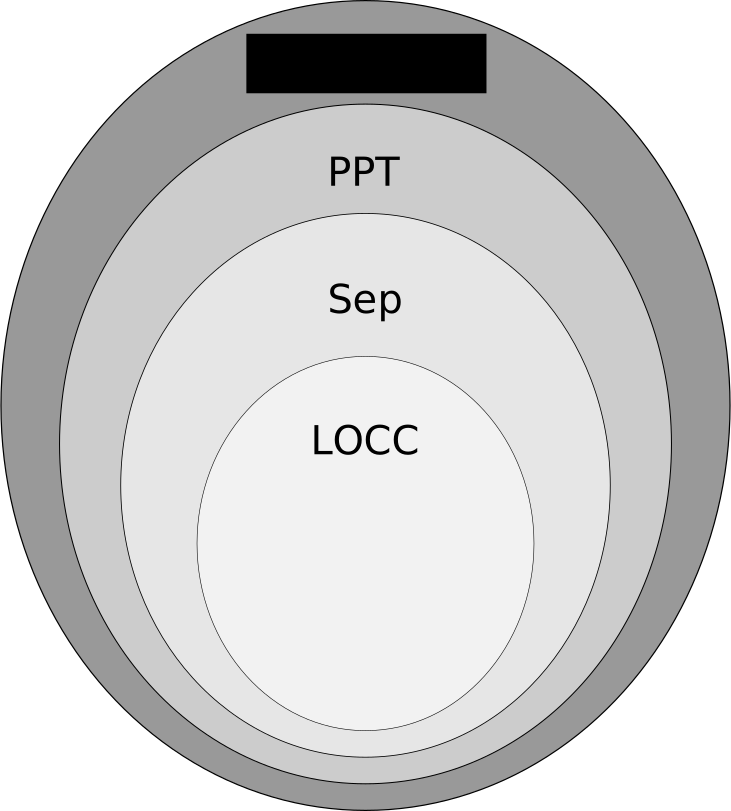{width="30%" .center} #Figure: Measurement hierarchy.
# That is,the probability that Alice and Bob are able to distinguish using PPT # measurements is a natural upper bound on the optimal probability of # distinguishing via separable measurements. # # In general: # # * LOCC: These are difficult objects to handle mathematically; difficult to # design protocols for and difficult to provide bounds on their power. # # * Separable: Separable measurements have a nicer structure than LOCC. # Unfortunately, optimizing over separable measurements in NP-hard. # # * PPT: PPT measurements offer a nice structure and there exists efficient # techniques that allow one to optimize over the set of PPT measurements via # semidefinite programming. # # # ### Optimal probability of distinguishing a quantum state # # The optimal probability with which Bob can distinguish the state he is given # may be obtained by solving the following semidefinite program (SDP). # # $$ # \begin{aligned} # \text{maximize:} \quad & \sum_{i=0}^n p_i \langle M_i, \rho_i \rangle \\ # \text{subject to:} \quad & \sum_{i=0}^n M_i = \mathbb{I}_{\mathcal{X}},\\ # & M_i \in \text{Pos}(\mathcal{X}). # \end{aligned} # $$ # # This optimization problem is solved in `|toqito⟩` to obtain the optimal # probability with which Bob can distinguish state $\rho_i$. # # To illustrate how we can phrase and solve this problem in `|toqito⟩`, # consider the following example. Assume Alice has an ensemble of quantum states # # $$ # \eta = \{ (1/2, \rho_0), (1/2, \rho_1) \} # $$ # # such that # # $$ # \rho_0 = | 0 \rangle \langle 0 | = \begin{pmatrix} # 1 & 0 \\ # 0 & 0 # \end{pmatrix} \quad \text{and} \quad # \rho_1 = | 1 \rangle \langle 1 | = \begin{pmatrix} # 0 & 0 \\ # 0 & 1 # \end{pmatrix}. # $$ # # These states are completely orthogonal to each other, and it is known that Bob # can optimally distinguish the state he is given perfectly, i.e. with probability # $1$. # # Using `|toqito⟩`, we can calculate this probability directly as follows: # import numpy as np from toqito.state_opt import state_distinguishability from toqito.states import basis # Define the standard basis |0> and |1>. e_0, e_1 = basis(2, 0), basis(2, 1) # Define the corresponding density matrices of |0> and |1> # given as |0><0| and |1><1|, respectively. E_0 = e_0 @ e_0.conj().T E_1 = e_1 @ e_1.conj().T # Define a list of states and a corresponding list of probabilities with which those # states are selected. states = [E_0, E_1] probs = [1 / 2, 1 / 2] # Calculate the probability with which Bob can distinguish the state he is provided. print(np.around(state_distinguishability(states, probs)[0], decimals=2)) # %% # Specifying similar state distinguishability problems can be done so using this # general pattern. # # ### Optimal probability of distinguishing a state via PPT measurements # # We may consider the quantum state distinguishability scenario under somewhat # different and more limited set of circumstances. Specifically, we may want to # ask the same question but restrict to enforcing that in order to determine the # state that Bob is provided, he is limited to using a certain class of # measurement. There are a wider class of measurements with respect to the ones # we considered in the previous example referred to as PPT (positive partial # transpose). # # The problem of state distinguishability with respect to PPT measurements can # also be framed as an SDP and was initially presented in this manner in # [@cosentino2013positive] # # $$ # \begin{aligned} # \text{minimize:} \quad & \frac{1}{k} \text{Tr}(Y) \\ # \text{subject to:} \quad & Y \geq \text{T}_{\mathcal{A}}(\rho_j), \quad j = 1, \ldots, k, \\ # & Y \in \text{Herm}(\mathcal{A} \otimes \mathcal{B}). # \end{aligned} # $$ # # Using `|toqito⟩`, we can determine the optimal probability for Bob to # distinguish a given state from an ensemble if he is only given access to PPT # measurements. # Consider the following Bell states # # $$ # \begin{aligned} # | \psi_0 \rangle = \frac{|00\rangle + |11\rangle}{\sqrt{2}}, &\quad # | \psi_1 \rangle = \frac{|01\rangle + |10\rangle}{\sqrt{2}}, \\ # | \psi_2 \rangle = \frac{|01\rangle - |10\rangle}{\sqrt{2}}, &\quad # | \psi_3 \rangle = \frac{|00\rangle - |11\rangle}{\sqrt{2}}. # \end{aligned} # $$ # # It was shown in [@cosentino2013positive] and later extended in [@cosentino2014small] that for the following set of states # # $$ # \begin{aligned} # \rho_1^{(2)} &= |\psi_0 \rangle | \psi_0 \rangle \langle \psi_0 | \langle \psi_0 |, \\ # \rho_2^{(2)} &= |\psi_1 \rangle | \psi_3 \rangle \langle \psi_1 | \langle \psi_3 |, \\ # \rho_3^{(2)} &= |\psi_2 \rangle | \psi_3 \rangle \langle \psi_2 | \langle \psi_3 |, \\ # \rho_4^{(2)} &= |\psi_3 \rangle | \psi_3 \rangle \langle \psi_3 | \langle \psi_3 |, # \end{aligned} # $$ # # that the optimal probability of distinguishing via a PPT measurement should yield # $7/8 \approx 0.875$. # # This ensemble of states and some of its properties with respect to # distinguishability were initially considered in [@yu2012four]. In `|toqito⟩`, # we can calculate the probability with which Bob can distinguish these states # via PPT measurements in the following manner. # import numpy as np from toqito.state_opt import state_distinguishability from toqito.states import bell # mkdocs_gallery_thumbnail_path = 'figures/quantum_state_distinguish.svg' # Bell vectors: psi_0 = bell(0) psi_1 = bell(2) psi_2 = bell(3) psi_3 = bell(1) # YDY vectors from [@yu2012four]: x_1 = np.kron(psi_0, psi_0) x_2 = np.kron(psi_1, psi_3) x_3 = np.kron(psi_2, psi_3) x_4 = np.kron(psi_3, psi_3) states = [x_1, x_2, x_3, x_4] probs = [1 / 4, 1 / 4, 1 / 4, 1 / 4] # Calculate the PPT distinguishability value. ppt_val, _ = state_distinguishability( vectors=states, probs=probs, measurement="ppt", subsystems=[0, 2], dimensions=[2, 2, 2, 2], ) # Print the rounded result. print(f"Optimal probability with PPT measurements: {np.around(ppt_val, decimals=2)}") # %% # ### Probability of distinguishing a state via separable measurements # # As previously mentioned, optimizing over the set of separable measurements is # NP-hard. However, there does exist a hierarchy of semidefinite programs which # eventually does converge to the separable value. This hierarchy is based off # the notion of symmetric extensions. More information about this hierarchy of # SDPs can be found here [@navascues2008pure]. # %%